Elite colleges have created a new game. It is not about academics anymore. It is not even about fairness or competition. The new hustle is crafty, cruel, and simple: if you can get your kid labeled “disabled,” they get extra time on tests, special rooms, private tutors, and exemptions from situations they find stressful. This is taking the “safe space” agenda to new grifter levels.
These benefits used to be reserved for people who actually needed them. Now, they’re being handed out like participation trophies for rich kids at Ivy League schools.
READ MORE: What’s happening in MN? Now, a Somali-run election scam is BREAKING on local news…
Most of the students claiming these so-called “disabilities” aren’t kids in wheelchairs or kids with severe cognitive challenges. They are privileged, high-performing suburban, upper middle-class teens from uber-wealthy families who show up at places like Stanford University, Harvard, and Brown with a little doctor’s note and suddenly get double time on exams. Once these schools made “disability accommodations” easy to get, the floodgates opened.
Before we dig deeper into this new hustle, here’s the X-post that lays out the insanity in simple terms. Derek’s X post gives you a quick snapshot of the madness happening on elite campuses right now. And the icing on this disabled cake is that experts now warn that some schools will have more “disabled” students than non-disabled ones.
– At Brown and Harvard, more than 20% of undergraduates are registered as disabled
– At Amherst: more than 30 percent
– At Stanford: nearly 40 percentSoon, many of these schools “may have more students receiving [disability] accommodations than not, a scenario that would have seemed absurd just a decade ago.”
As students and their parents have recognized the benefits of claiming disability—extended time on tests, housing accommodations, etc—the rates of disability at colleges, and especially at elite colleges, has exploded.
This is a great piece with some mind-boggling statistics.
– At Brown and Harvard, more than 20% of undergraduates are registered as disabled
– At Amherst: more than 30 percent
– At Stanford: nearly 40 percentSoon, many of these schools “may have more students receiving… pic.twitter.com/GEmr8Tw8Az
America used to stigmatize disability too severely. Now elite institutions reward it too liberally. It simply does not make any sense to have a policy that declares half of the students at Stanford cognitively disabled and in need of accommodations.
— Derek Thompson (@DKThomp) December 2, 2025
Here’s a closeup of the image:
The Atlantic article is a goldmine. It’s a blueprint on how this new grift works.
Let’s start with something as normal as taking a test. It used to be simple. You walked into a room, sat down, and got to work. Well, not anymore. At top schools, the “disabled” system has gotten so big that universities cannot even fit all the “troubled” students in the testing area.
Administering an exam used to be straightforward: All a college professor needed was an open room and a stack of blue books. At many American universities, this is no longer true. Professors now struggle to accommodate the many students with an official disability designation, which may entitle them to extra time, a distraction-free environment, or the use of otherwise-prohibited technology. The University of Michigan has two centers where students with disabilities can take exams, but they frequently fill to capacity, leaving professors scrambling to find more desks and proctors. Juan Collar, a physicist at the University of Chicago, told me that so many students now take their exams in the school’s low-distraction testing outposts that they have become more distracting than the main classrooms.
So the kids who claim they need “quiet space” now overcrowd the quiet space and turn it into a loud space.
Perfect metaphor for what this has become: a mini arms race to get even more advantages at places that are already overflowing with privilege.
Keep in mind, the “disabled” boom isn’t happening across the board. It is happening where all the big money is.
The Atlantic piece goes on:
At Brown and Harvard, more than 20 percent of undergraduates are registered as disabled. At Amherst, that figure is 34 percent. Not all of those students receive accommodations, but researchers told me that most do. The schools that enroll the most academically successful students, in other words, also have the largest share of students with a disability that could prevent them from succeeding academically.
So the smartest kids in the country have suddenly become the most disabled. Sure. That seems totally legit.
The professors know exactly what’s going on. The Atlantic piece has the goods:
“You hear ‘students with disabilities’ and it’s not kids in wheelchairs,” one professor at a selective university, who requested anonymity because he doesn’t have tenure, told me. “It’s just not. It’s rich kids getting extra time on tests.” Even as poor students with disabilities still struggle to get necessary provisions, elite universities have entered an age of accommodation. Instead of leveling the playing field, the system has put the entire idea of fairness at risk.
Wonderful. The disability system isn’t helping the weak students. It is helping the strong students get even stronger.
A big part of this explosion comes from the government lowering the standards for what counts as a disability.
Have you looked at a job interview form lately? You probably have at least 3 disabilities. Look:
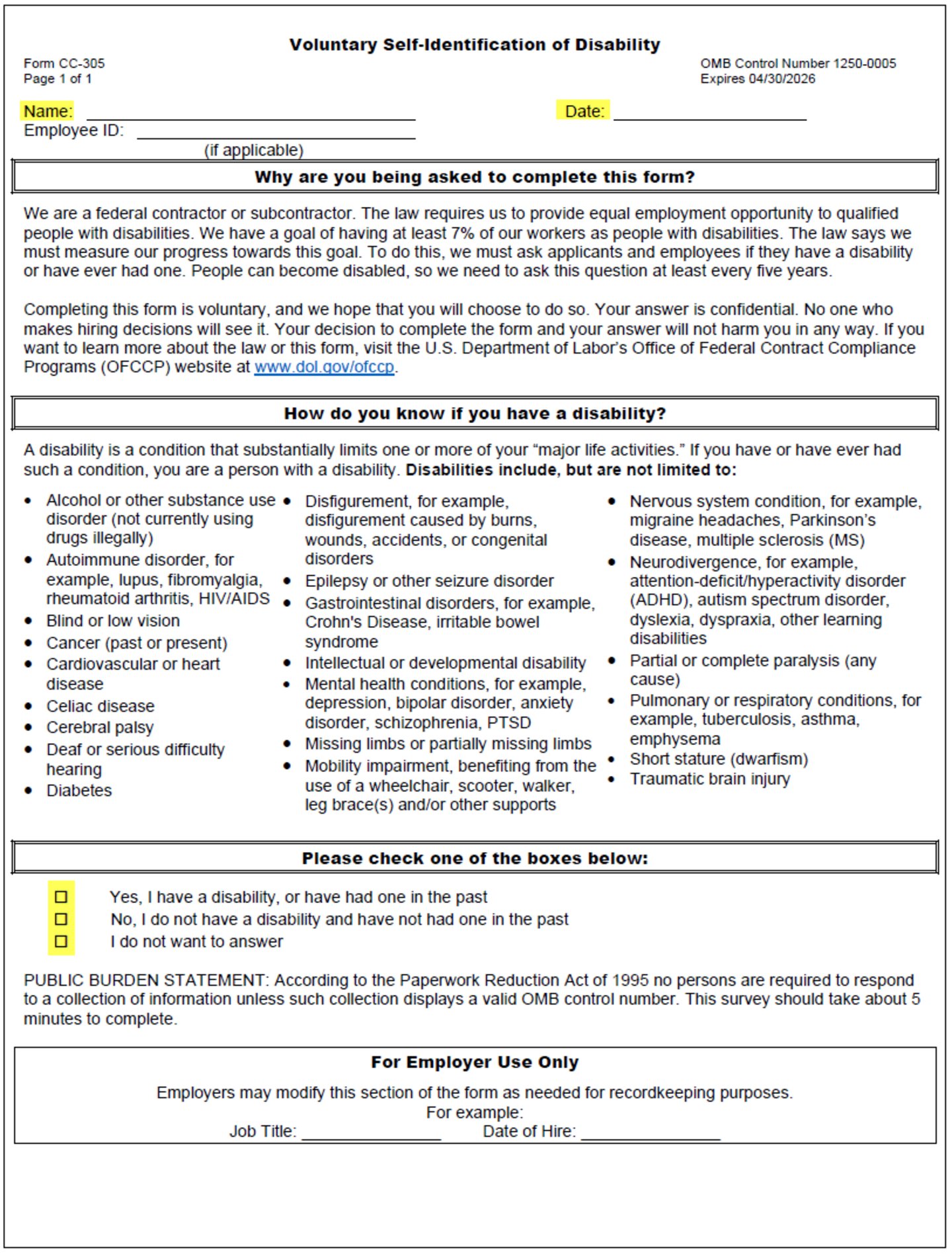
The moment the definition got softer, the diagnoses skyrocketed. The Atlantic piece continues:
Professors I spoke with told me that, even in the early 2000s, they taught only a handful of students with disabilities. Then, in 2008, Congress amended the ADA to restore the law’s original intent. The government broadened the definition of disability, effectively expanding the number of people the law covered. It also included a list of major life activities that could be disrupted by a disability (“learning, reading, concentrating, thinking,” among others) and clarified that individuals were protected under the ADA even if their impairment didn’t severely restrict their daily life.
If a student says they “struggle to focus,” that is now enough to get special privileges. And apparently, in America, wealthy kids are all riding the struggle bus.
And of course, the elites and Hollywood parents involved in the Varsity Blues scandal figured out the loophole with lightning speed.
The Atlantic piece explains:
The Varsity Blues college-admissions scandal showed that there are wealthy parents who are willing to pay unscrupulous doctors to provide disability diagnoses to their nondisabled children, securing them extra time on standardized tests. Studies have found that a significant share of students exaggerate symptoms or don’t put in enough effort to get valid results on diagnostic tests. When Weis and his colleagues looked at how students receiving accommodations for learning disabilities at a selective liberal-arts school performed on reading, math, and IQ tests, most had above-average cognitive abilities and no evidence of impairment.
If there’s a rule, wealthy families will find the back door in.
Researchers who actually study this kind of stuff admit that many of these “disabled” students are perfectly capable, with zero clinical impairment, yet it’s allowed to continue.
This is a grift.
And to make matters even worse, the administrators running the system admit they are drowning in this new hustle. The Atlantic piece concludes:
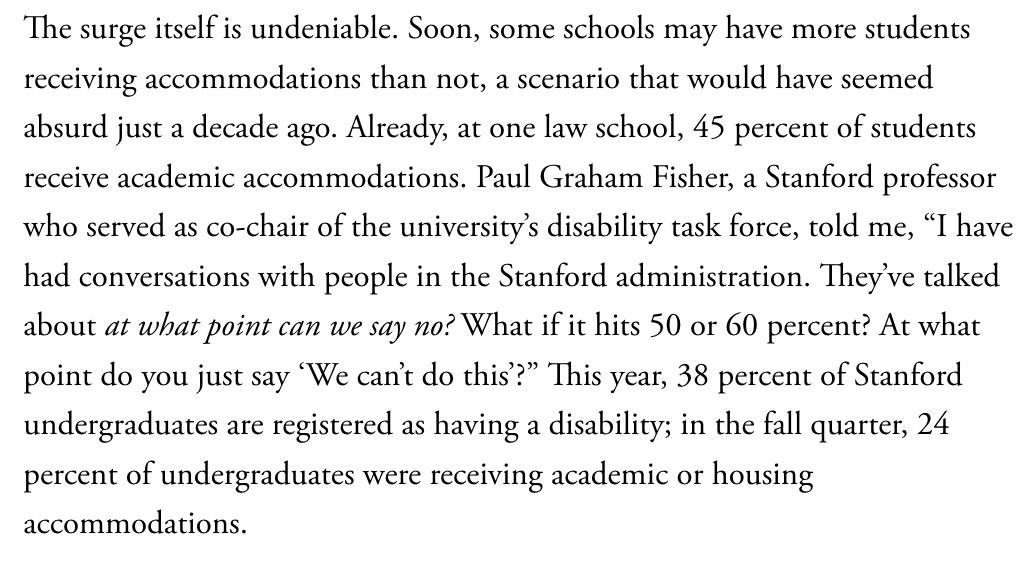
Soon, some schools may have more students receiving accommodations than not, a scenario that would have seemed absurd just a decade ago. Already, at one law school, 45 percent of students receive academic accommodations. Paul Graham Fisher, a Stanford professor who served as co-chair of the university’s disability task force, told me, “I have had conversations with people in the Stanford administration. They’ve talked about at what point can we say no? What if it hits 50 or 60 percent? At what point do you just say ‘We can’t do this’?” This year, 38 percent of Stanford undergraduates are registered as having a disability; in the fall quarter, 24 percent of undergraduates were receiving academic or housing accommodations.
When nearly half a campus claims disability, the word “disabled” stops meaning anything.
In the end, this whole mess is the perfect snapshot of what elite America has turned into. These schools claim they’re lifting up the vulnerable while quietly handing out golden tickets to the kids who don’t even need them. Disability isn’t some life challenge anymore; it’s a strategy for winning.
READ MORE: New FBI internal report has Americans asking: Time to burn it down and move on?
And the sad part is, nobody’s fixing it. Administrators see the numbers climbing and just shrug it off. Professors whisper about it off the record but don’t do anything to stop this nonsense. Parents treat diagnoses like private-school “starter packs.”
At this rate, if the definition of disability keeps expanding, the meaning of merit will collapse right along with it. It’s really sad, because America used to believe in rising to the challenge. Now the challenge is getting paperwork for why you shouldn’t have to rise, ever.
NEWSFEED — FOLLOW ON X — GAB — GETTR — TRUTH SOCIAL —

Join the Discussion